Thursday, May 24, 2012

For those of you playing along at home...

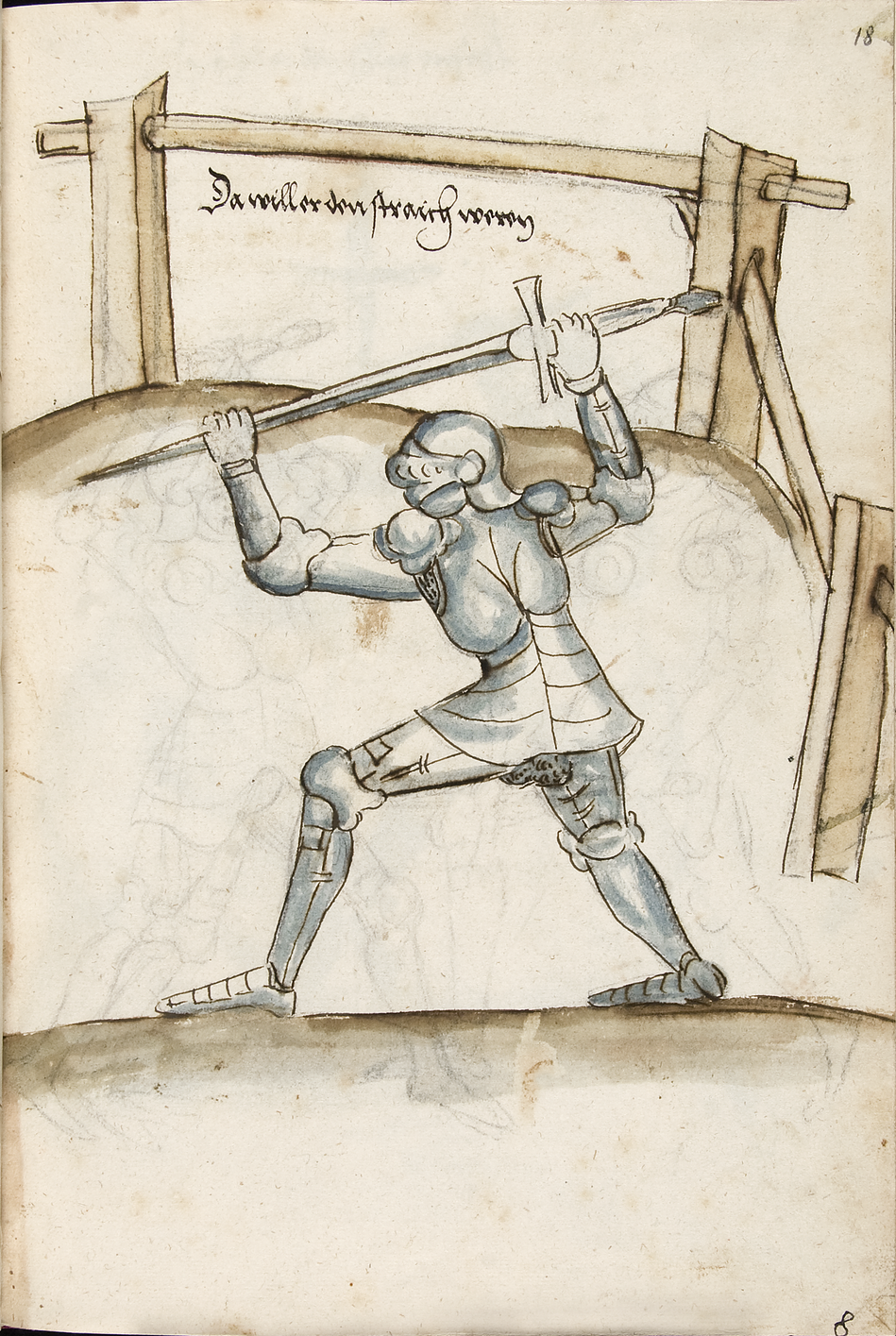
For those of you who missed class last Sunday, we did the Talhoffer Two-Step half-swording from supported striking:

http://wiktenauer.com/images/c/c3/MS_Ludwig_XV_13_11r-b.jpg


http://wiktenauer.com/images/c/cc/MS_Thott_290.2%C2%BA_87v.jpg


http://wiktenauer.com/images/6/65/MS_Thott_290.2%C2%BA_90r.jpg


http://wiktenauer.com/images/f/ff/Cod.I.6.2%C2%BA.1_18r.png


http://wiktenauer.com/images/0/09/Cod.icon.394a_35r.jpg

For every half-sword technique, think supported striking position like the first plate, above (Full Iron Gate - Doubled)

See y'all Sunday.


Wednesday, May 23, 2012

The life of a nobleman

In class last week, we talked much about historical martial arts. As we were drilling them, some basic fundamental rules/behaviors kept coming up. However, these are not something that I think is specific to Western Martial Arts, but are common in all fighting activities.

When I talk about "The Life of a Noblemen", I'm not talking about what fork to eat with, what dress to wear, or anything like that. I'm talking about how to PRESERVE the "life" of a noblemen, and what someone of Noble life must do to defend themselves and be a quality combatant.

Before the modern era, the only well trained, cultivated fighters were those who could afford it. This almost always meant Nobles/Aristocracy.

The reason?

The majority of the peasantry were laborers. They probably were more sickly than the Nobles, but they were almost surely in better general shape.

Chopping wood builds more muscle than watching your jester.

So as we look back in history, we find many manuals on "How to keep a Noble from getting his ass kicked by the laborer".

In all cultures, the government spent plenty of dough to keep their place at the top. America kinda ruined this whole thing, but that's a different story.

So what does history tell us to do to fight like a "Noble"?

1. Keep your head up
Throughout historical pictures, and literature, posture told the whole story.


As you can see, peasants walked with slouched posture. They kept their heads low, and their ambitions lower. Proper posture is reserved for those with the pointy hats. And only them. Why do you think Bowing is such a big deal? Peasants bow before Nobles. Nobles never bow before Peasants. The life of a Noble means you don't bow to anyone.

How does this apply to martial arts?

A big piece in fighting is putting the other guy in a submissive position to you. Sometimes that's a KO, a Submission, or just plain getting the guy to treat you with more respect (bullies?). So how do the Nobles do this? They get the peasant who they are fighting to look at the ground. And as I say in class, "if I can get you to look at the ground, I will put you there". I did not invent the concept, and it is a resounding tone throughout history.

Nobles hold their head high so they exert confidence too! How to avoid a fight? Look more confident than the next victim. If you look more Noble than the other guy, the other guy will get jumped.

Peasants are distracted, depressed, and always looking for a master. Crooks love peasants.

2. Literacy
This is a strange one that might confuse you. Let me explain.

In history, one of the greatest dividers between the rich and the poor is literacy. The poor can't read, the rich could. The rich could write a manual on fighting, and give it to all their fellow nobles, and circulate the information. The poor had to pass on teachings through dance, folk wrestling, and song.

Nobles didn't ignore the peasant way of doing things, they stole it. They would do the peasant things, AND learn from the finely written manuals! They would take the good from the peasant systems, and encode it in their well written guides, then go beat up peasants. In other words, literacy gives you the best of both worlds: Peasant teachings and Noble wisdom.

How does this apply to us? Simple. Jimmy the Crackhead learned to sling dope and fight from his older brother, his friend at school, and MTV. Billy in the Trailer Park learned to fight from his old man, learned to walk like a rooster from his big brother, and learned to fight the cops from just about everyone else in his complex. What they don't learn from? Books.

We can take their styles, mix them with thousands of years of martial history, mix it with modern thought, watch expensive UFC fights, and continue to blend these together. Nobles have more methods of learning than peasants.

3. The Law
Much like literacy, Peasants don't know the law. They have a moral compass, but other than that they don't have a clue what the law says. It makes things very easy for their rulers: Tell them they broke the law, administer whatever punishment they want, then go away. Taxes, Sumptuary Law, Property Law, Hunting Law were all things that the Nobles came up with to punish peasants whenever they saw fit. In the case of Sumptuary law, they could punish the rich folks, to make them peasants. Brilliant...

How does this apply to us?

As a martial artist, you MUST know the self defense laws of your state/city. There is no point learning to fight if you can't do it lawfully. If a guy throws a bit of garbage into your yard, and you roundhouse kick him for it, you are now the crook. It's important to know the Law! Learn the law, defend yourself, and be a noble!

4. Clothing
With the whole Trayvon thing, folks have been talking about Hoodies way to much. Way way too much, actually. The thing to gather from history (and Geraldo) is that despite what you may think, others pass judgement about your clothing and dress. If you wear a hoodie, there are some members of the public who think you are up to no good. If you wear a suit, there are certain members of society that think you are banker. What do the peasants see? What do the crooks see?

Sometimes it's to your advantage to look like a peasant. Would you go into North Minneapolis at 2 AM wearing a Tuxedo? Would you try to eat at a 5 star restaurant with a pair of shorts and flip flops? Your garments matter. No mater what you think of them, society shall pass judgement.

Furthermore, Peasants wear easy to rip, low quality clothes. Heavy garments were worn by the Nobles to show wealth, and to offer protection in some cases. Does wearing a studded motorcycle jacket offer you protection from attacks? Sure! Do flip flops take away your Savate ability? Yep!

Think about what you put on for clothing each day. Are you looking like a Peasant, or a Noble?


There you have it, some basics on "how to be a noble" when it comes to street survival. I encourage you all to dwell on this and think about what you want to be!

Friday, May 4, 2012

Words from a Predator


An interview with a serial rapist who talks about his methods and even motive.

Although most of our students are men, the insight into how a predator works and thinks is interesting and valuable to one of the types of people we are training ourselves to deal with.

Wednesday, April 18, 2012

Interesting fitness article.

Hey everyone,

I know that fitness is a common theme here so I thought I would post an article that I came across that I thought was very good!

Are you as fit as a WW2 GI? Find out!

http://www.itstactical.com/fitcom/functional-strength-fitcom/are-you-as-fit-as-a-world-war-ii-gi/

Saturday, April 14, 2012

A story from France

"I walked onto the University of Minnesota Football Team my Freshman year. Just showed up for tryouts, and they let me play. You remember __(Famous Uof M alumni pro football player)___? Well, his Sr. year was the season I played. Before he went to the NFL, he played in NFL Europe. We visited him, and we went to a bar in Versailles. He was about 235 lbs, and in the peak of his conditioning. He started running his mouth to some French-guy. The French-guy was about 150, maybe 160 lbs. I don't really know how the fight started, but the French-guy fired a single kick into the thigh of my teammate. He went down like a sack of bricks. Long story short, he ended up having so many broken blood vessels from that single kick, that it turned into a clot. The clot calcified, and ended up taking him out for half a season. We went to France not knowing what the word Savate meant, but that scrawny French-guy taught us."

The above story was told to me by a friend of mine.  It's not EXACTLY word for word, but it's damn close. What's the moral of the story?

1. Just because someone isn't carrying a weapon, doesn't mean that they don't have a hidden way of busting you up.

2. Respect all type of attacks. Just because you don't understand someone's fighting style, doesn't protect you from it.

3. Size matters, but it's not everything.

4. Every fight avoided, is a fight won.

5. Notice how the Frenchman never got his ass kicked by all the meat-heads from the USA? He ran. That's a good idea.

Saturday, April 7, 2012

At What Point?

Just saw this video posted and it contains some interesting items. Although poor quality, I think it shows some excellent behavior indicators we talk about.

http://broadbandsports.com/node/29230

The question which is the title of this post is: At what point do you, the target, decide it's 'Go time'? The guy in the white shirt starts showing predatory and aggressive body language almost right from the start. No need to listen to words spoken (the video doesn't pick them up anyway), just look at what his whole body is saying.

Say you are the guy in the red shorts. Do you decide when he is tracking and stalking you that this guy is a real threat? Do you do it when he raises what appears to be a weapon and puts it in your face? I have a hard time telling, but it could be a small pistol or an object which looks like one. Do you wait to find out for sure? Do you take action when the thug grabs or shoves you?

The target decides to wait until later, and gets the better of his attacker but take notice of the situation. He shifts momentum in his favor not by skill or swift action, but because he has the time to do it. It also appears the aggressor was more bark than bite. Perhaps he felt being big and having a weapon was enough to not worry about his target fighting back. Also notice the victim had friends around and the thug didn't.

My guess is that if the guy in the white shirt was a gang member or just a self-appointed street tough, he was probably a noob who learned a couple of big lessons from that engagement. More than likely, he won't need to learn them twice. He may not be the brightest bulb on the tree, but he probably will be quick to make sure next time that he has more friends on hand than his target and will be taking the first shot.

I digress a bit. What stood out to me so clearly was the stalking, tracking, puffing up, and (evidently) weapon display which made it clear he meant trouble. From the target's perspective, notice the fence he kept putting up and the aggressor moved through. I'm quite certain none of us would wait around as long as red trunks guy did to change the aggressor's mind about pushing the issue.

It is a good thing when these behaviors are known and understood so we can spot them and, should we need to, articulate them.

The other thing I noticed is how long the big fella keeps grasping on. There are several points he could allow red shorts guy to disengage, but he keeps holding on. Perhaps he realizes if he lets go he might get the soccer treatment. Lesson for my mind: Be ready to keep 'guns on' until it is over and the dust has started to settle. It ain't over 'till it's over.

Monday, April 2, 2012

Intel Skills and Knowledge

We talk about observation, awareness, and intelligence in class from time to time. It is difficult to feel like we are making the most of mat time by sharing information like this instead of doing reps. The reps are crucial and I wouldn't want our sessions to be gabfests.

However, I feel the stuff this article brings up is just as critical for our survival as having our motions down pat and probably even more so. Read and consider for yourself.

http://personalliberty.com/2012/04/02/intelligence-gathering-for-personal-safety/?eiid=

This sentence really stood out to me:
"Every single attack you avoid is a battle won."

While we train diligently to act correctly when we do not or cannot avoid the attack, this concept is a key to the art of self-protection. I encourage you to pass this article along to others who may not have the interest or availability to train in the art of self-defense, because reading stuff like this and knowing it is better than nothing.

As for us, we must keep up the training and make sure we do what we can to not use it unless absolutely necessary.